| Internet-Draft | Local Delegated Agent Identity | April 2026 |
| Malnick, et al. | Expires 1 November 2026 | [Page] |
This document specifies a reference architecture for the Agent Identity Management System (AIMS) conceptual model, as introduced in the NIST concept paper [NIST-AIMS] and elaborated in [AI-AUTH], applied to the local delegated agent profile. It defines the identity architecture for delegated AI agents that execute on end-user devices (laptops, desktops) or in browser-based sandboxes, acting on behalf of a technical user. The architecture composes existing and emerging IETF, W3C, FIDO Alliance, and OpenID specifications, supplemented by the OS-level peer-process verification protocol of the companion document [OS-Workload-Attestation], to realize each of the seven AIMS functions: Identifier, Credentials, Attestation, Provisioning, Authentication, Authorization, and Monitoring. Section 4.4 maps each AIMS function to the section of this document that realizes it.¶
This document is a reference architecture, not a protocol specification. It does not define new wire protocols; it defines how to compose existing ones for this profile. Vendor-specific extensions encountered during reference-implementation work, most notably a custom delegation-relationship identifier and proof-of-possession mechanisms for the delegated access token, have been deliberately excluded from this revision and deferred to separate work, so that the architecture is grounded only in capabilities that exist in shipping or actively-drafted specifications today.¶
Security gaps inherent to the local trust boundary are enumerated alongside candidate mitigations.¶
This document is the first in a six-part series specifying a reference architecture for AI agent identity across three authority models, each with a local and a remote variant. The three authority models are: human-delegated agents, which act on behalf of a present human Subject under that Subject's explicit consent; machine- or application-bounded agents, which act under the authority of a system or workflow rather than a specific human and are constrained to a pre-declared scope; and fully autonomous agents, which pursue a goal over time with minimal direct human oversight. Each model has a local variant (executing on an end-user device or in a browser sandbox) and a remote variant (executing in managed cloud compute), yielding the six combinations covered by the series. This document covers the local human-delegated profile.¶
Companion documents, most notably [OS-Workload-Attestation] for OS-level peer verification and the Remote Delegated companion for the cloud-managed compute profile, share the AIMS framing and refer to this document for the local-delegated-specific composition.¶
This Internet-Draft is submitted in full conformance with the provisions of BCP 78 and BCP 79.¶
Internet-Drafts are working documents of the Internet Engineering Task Force (IETF). Note that other groups may also distribute working documents as Internet-Drafts. The list of current Internet-Drafts is at https://datatracker.ietf.org/drafts/current/.¶
Internet-Drafts are draft documents valid for a maximum of six months and may be updated, replaced, or obsoleted by other documents at any time. It is inappropriate to use Internet-Drafts as reference material or to cite them other than as "work in progress."¶
This Internet-Draft will expire on 3 October 2026.¶
Copyright (c) 2026 IETF Trust and the persons identified as the document authors. All rights reserved.¶
This document is subject to BCP 78 and the IETF Trust's Legal Provisions Relating to IETF Documents (https://trustee.ietf.org/license-info) in effect on the date of publication of this document. Please review these documents carefully, as they describe your rights and restrictions with respect to this document.¶
AI agents operating in the delegated authority model act on behalf of a human Subject, inheriting that Subject’s permissions and executing tasks within the scope of an explicit delegation. This document addresses the specific variant in which such an agent runs locally: either as a native process on a user’s machine (laptop, desktop, or technical workstation) or within a browser-origin sandbox (web application, browser extension, or WebAssembly module).¶
These environments share a defining characteristic: the agent executable and any keys it manages reside in a space controlled by the end user, not by a managed infrastructure provider. This creates a fundamentally different threat model compared to a remote agent running inside a cloud-controlled compute environment:¶
The execution environment is not hardware-attested by default. No trusted execution environment (TEE) or TPM binding to a managed compute node is available.¶
The user is physically present and typically initiates the agent interactively, which enables human-in-the-loop consent flows unavailable in headless cloud deployments.¶
Secret material (tokens, keys) is at elevated risk from local credential theft, process injection, and memory scraping by other processes running under the same OS user account.¶
Browser-based agents additionally face origin-bound credential scoping, malicious extensions, cross-origin leakage, and prompt injection via DOM manipulation.¶
Despite these constraints, the local delegated agent is among the most prevalent agent patterns today: AI coding agents (e.g., terminal-based agentic tools that query upstream APIs and execute commands on behalf of a user), local LLM orchestrators, and IDE-integrated assistants all fit this profile.¶
The Agent Identity Management System (AIMS) conceptual model originates in the NIST concept paper [NIST-AIMS] and is elaborated as a normative seven-function framework in [AI-AUTH]. AIMS describes the set of functions required to establish, maintain, and evaluate the identity and permissions of an agent workload: Identifier, Credentials, Attestation, Provisioning, Authentication, Authorization, and Monitoring. AIMS itself is a model, not a wire protocol; it does not prescribe the specific transports, token formats, or platform primitives used to realize each function.¶
This document is a reference architecture for AIMS in
the local-delegated profile. Each AIMS function is bound to a concrete
specification or specification cluster: SPIFFE workload identifiers
[SPIFFE], JWT-SVID credentials [WIMSE-CREDS], OS-mediated peer
attestation per [OS-Workload-Attestation], JIT credential provisioning
via the Workload API of [OS-Workload-Attestation] Section 3, OAuth
Token Exchange [RFC8693] for authentication, scope-attenuated
delegated access tokens with per-call Txn-Token [OAUTH-TXN-TOKENS]
propagation for authorization, and the audit and revocation surface of
Section 8 for monitoring. Where two or more profiles in the 1Password
agent identity series share an AIMS function realization, the
realization is specified once in the appropriate companion document and
referenced from each profile that uses it; where a function differs by
profile, this document specifies the local-delegated composition
explicitly.¶
Section 4.4 provides the AIMS function-to-section mapping. Sections 5 through 8 correspond, in order, to the AIMS functional groups of identity establishment, authentication, authorization, and monitoring. Section 12 enumerates work deliberately deferred from this revision.¶
An implementation conforms to this reference architecture if it realizes each AIMS function as specified in the corresponding section, satisfies the normative requirements of the [OS-Workload-Attestation] companion (which this document references as the realization of the Attestation and Provisioning functions), and does not relax the security properties enumerated in Section 10. An implementation that omits a function, for example by omitting Monitoring or relaxing the per-issuance peer verification of [OS-Workload-Attestation] Section 4, does not conform to this profile. Implementations MAY add capabilities beyond those specified here (for example, the deferred work enumerated in Section 12), provided the additions do not weaken the security properties of any AIMS function realized in this document.¶
The key words MUST, MUST NOT, REQUIRED, SHOULD, SHOULD NOT, RECOMMENDED, and MAY in this document are to be interpreted as described in BCP 14 [RFC2119] [RFC8174].¶
Agent: A workload capable of LLM-guided reasoning and tool execution.¶
AIMS: Agent Identity Management System. The conceptual seven-function model originating in [NIST-AIMS] and elaborated in [AI-AUTH]. Functions: Identifier, Credentials, Attestation, Provisioning, Authentication, Authorization, Monitoring.¶
Subject: The technical user on whose behalf the agent acts.¶
Delegation: The explicit, scoped transfer of authority from Subject to Agent.¶
Local Agent: An agent process running on the Subject’s device or in a browser origin controlled by the Subject’s session.¶
Browser-Sandbox Agent: An agent executing within a browser’s JavaScript / WASM origin. Treated as equivalent to local agent for purposes of this document.¶
IdP: Identity Provider. Issues identity tokens (ID tokens) about the Subject.¶
AS: Authorization Server. Issues access tokens and manages authorization grants.¶
WIB: Workload Identity Broker. The architectural component that brokers verifiable workload identity for local agents. Specified in [OS-Workload-Attestation] and applied in Section 5.2 of this document.¶
TTS: Transaction Token Service
[OAUTH-TXN-TOKENS]. Issues Txn-Tokens scoped to a single transaction
call-chain.¶
Txn-Token: A short-lived,
signed JWT that propagates immutable identity and intent context through
a call chain.¶
WIMSE ID: A URI-format workload identifier as defined in [WIMSE-IDENTIFIER].¶
SPIFFE ID: The SPIFFE realization of a workload identifier per [SPIFFE]. In this document, the workload identifier scheme used to realize the AIMS Identifier function.¶
JWT-SVID: A SPIFFE Verifiable Identity Document encoded as a signed JSON Web Token. The credential format used to realize the AIMS Credentials function.¶
PDP: Policy Decision Point. Evaluates authorization policy against runtime signals.¶
PEP: Policy Enforcement Point. Enforces decisions from the PDP.¶
PKCE: Proof Key for Code Exchange [RFC7636]. Prevents authorization code interception attacks in public clients.¶
act claim: JWT ‘actor’ claim carrying the agent’s identifier, distinguishing it from the delegating Subject.¶
Intent Binding: The
cryptographic association of a Txn-Token with the specific user-declared
goal that initiated the agent task.¶
Prompt Injection: An attack in which adversarial content in agent tool outputs manipulates the LLM’s subsequent actions beyond the user’s intended delegation scope.¶
The following table lists all normative and informative specifications referenced in this document. Status reflects standing as of April 2026. The AIMS source documents [NIST-AIMS] and [AI-AUTH] are listed first as the conceptual model this document realizes; the remaining entries are organized by AIMS function area where applicable.¶
| Tag | Title | Status | AIMS Function |
|---|---|---|---|
| [NIST-AIMS] | NIST AIMS Concept Paper | NIST Concept Paper | Model (all) |
| [AI-AUTH] | AI Agent Authentication and Authorization | I-D (Emerging) | Model (all) |
| [OS-Workload-Attestation] | OS-Level Workload Attestation | Companion (this series) | Attestation, Provisioning |
| [SPIFFE] | SPIFFE: Secure Production Identity Framework for Everyone | Standard (Informative) | Identifier, Credentials |
| [WIMSE-IDENTIFIER] | WIMSE Workload Identifier | I-D (Emerging) | Identifier |
| [WIMSE-CREDS] | WIMSE Workload Credentials | I-D (Emerging) | Credentials |
| [WIMSE-ARCH] | WIMSE Architecture | I-D (Emerging) | Identifier, Credentials |
| [WIMSE-S2S] | WIMSE Workload-to-Workload Authentication | I-D (Emerging) | Authentication |
| [WIMSE-HTTP-SIG] | WIMSE Workload-to-Workload Auth with HTTP Signatures | I-D (Emerging) | Authentication |
| [RFC6749] | OAuth 2.0 Authorization Framework | RFC (Normative) | Authentication, Authorization |
| [RFC7636] | PKCE for OAuth Public Clients | RFC (Normative) | Authentication |
| [RFC8693] | OAuth 2.0 Token Exchange | RFC (Normative) | Authentication |
| [RFC9700] | OAuth 2.0 Security BCP | RFC/BCP (Normative) | Authentication |
| [RFC9068] | JWT Profile for OAuth 2.0 Access Tokens | RFC (Normative) | Credentials |
| [RFC7519] | JSON Web Token (JWT) | RFC (Normative) | Credentials |
| [RFC7591] | OAuth 2.0 Dynamic Client Registration | RFC (Normative) | Provisioning |
| [RFC9421] | HTTP Message Signatures | RFC (Normative) | Authentication |
| [OAUTH-v2.1] | The OAuth 2.1 Authorization Framework | I-D (Informative) | Authentication |
| [OAUTH-TXN-TOKENS] | Transaction Tokens (Txn-Tokens) |
I-D (Emerging) | Authorization |
| [OAUTH-TXN-AGENTS] | Transaction Tokens For Agents | I-D (Emerging) | Authorization |
| [OAUTH-CHAIN] | OAuth Identity and Authorization Chaining Across Domains | I-D (Emerging) | Authorization |
| [OAUTH-ID-JAG] | Identity Assertion JWT Authorization Grant | I-D (Emerging) | Authentication |
| [OAUTH-ATTEST] | OAuth 2.0 Attestation-Based Client Authentication | I-D (Emerging) | Attestation |
| [OIDC-Core] | OpenID Connect Core 1.0 (errata 2) | Final (Normative) | Authentication |
| [WebAuthn-L3] | Web Authentication Level 3 | W3C Working Draft | Authentication |
| [FIDO2-CTAP] | FIDO2 Client-to-Authenticator Protocol (CTAP2) | FIDO Proposed Standard | Authentication |
| [CAEP] | OpenID Continuous Access Evaluation Profile 1.0 | OpenID Final | Monitoring, Authorization |
| [NIST-63-4] | NIST SP 800-63-4 Digital Identity Guidelines | NIST Final (July 2025) | Authentication |
| [NIST-207] | NIST SP 800-207 Zero Trust Architecture | NIST Final | Model (all) |
| [RATS-ARCH] | Remote Attestation Procedures (RATS) Architecture | RFC 9334 | Attestation |
| [MCP] | Model Context Protocol Specification | Informational | (reference) |
The local delegated agent architecture consists of the following components operating within or adjacent to the local trust boundary. Each component participates in one or more AIMS functions; Section 4.4 enumerates the function-to-section mapping for the AIMS reader.¶
Human Subject : The technical user who initiates the agent task, provides consent, and retains ultimate authority over the agent’s delegated scope. Source of the AIMS Authentication input at consent time and of the user-presence assertions consumed by the Authorization function.¶
The local agent workload. Runs as a native OS process (e.g., a CLI tool, a desktop application, an Electron app) or as JavaScript / WASM inside a browser origin. Holds ephemeral credentials scoped to the delegated resource and a WIMSE-compatible identifier. The bearer of the AIMS Identifier and the consumer of AIMS Credentials issuance.¶
Identity Provider (IdP) : Authenticates the human Subject and issues ID tokens (OIDC). Acts as the root of trust for the delegation chain. Realizes the human-side AIMS Authentication function. Typically a remote OIDC-compliant enterprise IdP accessed over TLS.¶
Authorization Server (AS) : Issues access tokens scoped to specific resources and delegations. Operates as a federated relying party to the IdP for human authentication, and as the OAuth Authorization Server for downstream Resource Servers. Processes the Token Exchange (Section 7.1) that elevates the Subject’s federated access token into an agent-scoped delegated access token carrying the act claim. Validates WIB-issued JWT-SVIDs (Section 5.2) presented as actor_token against its enrolled-WIB trust bundle. Realizes the agent-side AIMS Authentication and Authorization functions. The AS’s endpoint surface is detailed in Section 4.3.¶
A code-signed local daemon that mediates identity issuance to agent workloads on the Subject’s device. Holds a device-bound key pair enrolled with the AS (Section 5.2.2), exposes a SPIFFE-style Workload API to local agents per [OS-Workload-Attestation] Section 3, and issues short-lived JWT-SVIDs after performing OS-level peer-process verification per [OS-Workload-Attestation] Section 4. The WIB is the architectural component that realizes the AIMS Attestation function on unattested local hardware and the AIMS Provisioning function (JIT issuance per task). Specified in detail in Section 5.2.¶
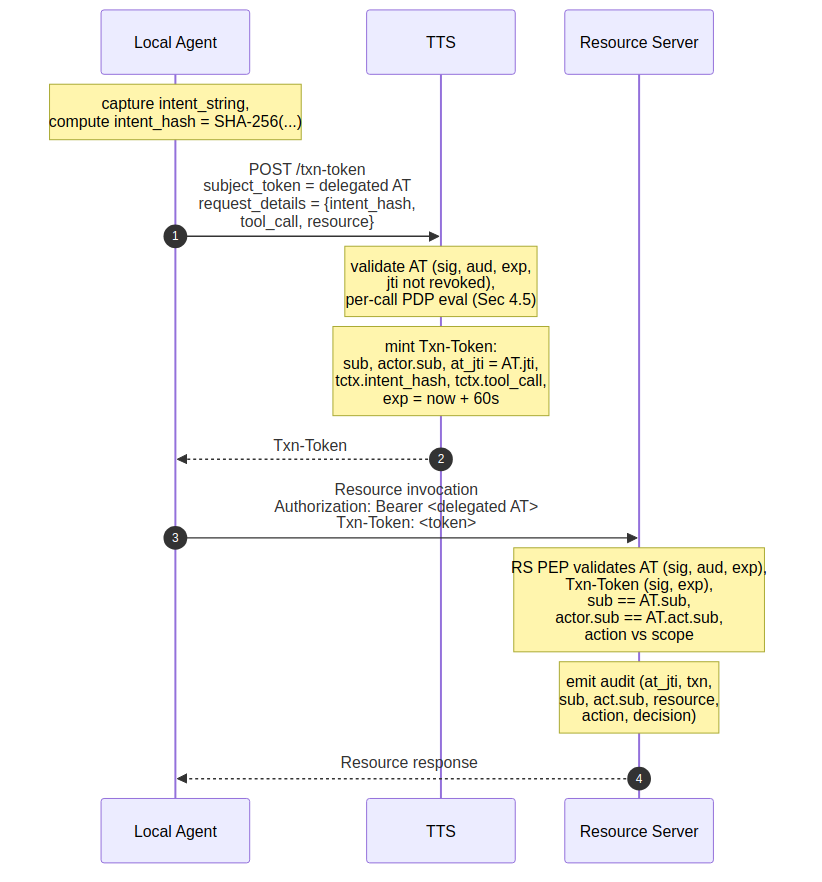
Issues short-lived Txn-Tokens per
[OAUTH-TXN-TOKENS] and [OAUTH-TXN-AGENTS]. Binds the transaction’s
immutable context (subject identity, agent identity, user intent).
Logically distinct from the AS, but typically realized as an
additional endpoint on the AS within the same trust authority (Section
4.3.4). Realizes the per-call leg of the AIMS Authorization function.
The endpoint name and grant_type semantics defined in
[OAUTH-TXN-TOKENS] are an emerging Internet-Draft and SHOULD be
expected to change. Each logical trust domain MUST have exactly one
TTS.¶
An architectural role per [NIST-207].
Realized by each Resource Server’s request-validation layer, which
validates the access token’s signature and audience, the Txn-Token’s
identity context and intent hash, and the requested action against the
granted scope. Realizes the enforcement leg of the AIMS Authorization
function and the per-call audit emission consumed by AIMS Monitoring
(Section 8). The PEP is not a separately-deployed service in this
architecture.¶
Resource Server(s) : The
upstream services the agent interacts with (APIs, databases, SaaS
apps, MCP servers). Validate access tokens and / or Txn-Tokens, and
enforce resource-level access policy.¶
Credential Store : A secure local secret store backed by the platform OS (macOS Keychain with Secure Enclave, Windows DPAPI / CNG with TPM, Linux Secret Service / TPM where available, or in-browser Web Crypto non-extractable keys). Used by the WIB to hold its enrolled device-bound key. The agent process itself does not hold long-lived asymmetric key material in this profile (the agent’s identity is established by presenting the WIB-issued SVID rather than by holding its own key); the Credential Store’s role here is to protect the WIB’s device key and any short-lived material the agent obtains from the AS. The substrate that protects AIMS Credentials at rest in the local trust domain.¶
This architecture spans two trust domains:¶
Local Trust Domain : The agent process, the credential store, the WIB, and any locally-bound tool processes. Bounded by the OS user account / browser origin. Inherently lower assurance than a managed server environment.¶
Remote Trust Domain : The IdP, AS, TTS, PDP, and Resource Servers. Operates in managed infrastructure. Connected to the Local Trust Domain over mutually authenticated TLS channels.¶
Tokens MUST NOT flow between trust domains without
validation at the boundary. The agent’s access token, minted by the
remote AS with the Subject’s delegation, crosses from Remote to Local
when delivered to the agent. The Txn-Token, once minted for a call
chain, crosses from Local to Remote with each API call.¶
The seven AIMS functions, as defined in [NIST-AIMS] and [AI-AUTH], are realized in this document as follows. The right-hand column lists the protocol or specification that supplies the wire-level mechanics; this document supplies the local-delegated-specific composition and the normative requirements that bind the parts together.¶
| AIMS Function | Realization in this document | Underlying mechanism |
|---|---|---|
| Identifier | Section 5.3: SPIFFE ID assigned per agent instance, encoded as the sub claim of the WIB-issued JWT-SVID and propagated as the act.sub of the delegated access token. |
[SPIFFE], [WIMSE-IDENTIFIER] |
| Credentials | Section 5.3.2: JWT-SVID minted by the WIB, signed with the WIB's enrolled device key. Lifetime ≤ 10 minutes. Section 7.1 delegated AT minted by AS, lifetime ≤ 15 minutes. Section 7.3 Txn-Token, lifetime ≤ 60 seconds. |
[WIMSE-CREDS], [RFC9068], [OAUTH-TXN-TOKENS] |
| Attestation | Section 5.2.4: OS-level peer-process verification performed by the WIB on every issuance, six-step flow with platform-specific realization. Outcome reflected in the attest_methods SVID claim. | [OS-Workload-Attestation] §4 |
| Provisioning | Section 5.2.3: Workload API (FetchJWTSVID) over a host-only IPC channel, single-shot or long-lived-with-revalidation connection model. JIT issuance per agent task; no pre-minting. | [OS-Workload-Attestation] §3 |
| Authentication | Section 6.1: human Subject authenticates to the IdP via WebAuthn / FIDO2 (AAL2 minimum, AAL3 with hardware-attested device-bound passkey). Section 6.2: agent authenticates to the AS via OAuth 2.0 Token Exchange presenting the WIB-issued SVID as actor_token; the SVID itself is the proof of agent identity. | [WebAuthn-L3], [FIDO2-CTAP], [RFC8693], [NIST-63-4] |
| Authorization | Section 7.1: delegated access token with mandatory scope attenuation and sub / act split. Section 7.3: per-call Txn-Token carrying immutable identity and intent context. Section 7.4: intent binding via SHA-256 of user-declared task. PDP evaluation per Section 4.5. |
[RFC8693], [OAUTH-TXN-TOKENS], [OAUTH-TXN-AGENTS] |
| Monitoring | Section 8: audit emissions at each PEP keyed on standard JWT identifiers (the AT's jti and the Txn-Token's txn), revocation propagation, and CAEP-based real-time signaling. |
[CAEP], this document §8 |
The mapping above is the contract this reference architecture keeps with the AIMS model. An implementation that omits any row MUST NOT claim conformance to this profile, regardless of the strength of the remaining rows; the AIMS model treats the seven functions as jointly necessary.¶
The Policy Decision Point is an architectural role per [NIST-207] and a first-class component of the AIMS Authorization function per [AI-AUTH] Section 4. This section makes the PDP’s presence and operation explicit, separately from the architecture’s component inventory, because the document treats authorization as the function under which the most policy decisions are made and the function for which the cleanest existing-spec mapping exists.¶
In this reference architecture, the PDP is realized as
policy evaluation embedded within the AS’s /token and /txn-token
endpoints rather than as a separately-deployed service. There are two
PDP evaluation points, each with distinct inputs and a distinct decision
class:¶
Per-task PDP evaluation at /token.
Inputs: the Subject’s federated access token
(sub, scopes, audience), the WIB-issued JWT-SVID and its
attest_methods claim (the AIMS Attestation evidence; see Section
5.3.2), the standing delegation policy recorded at /authorize for this
(Subject, agent) pair, and the requested scope. Decision: whether to
mint a delegated access token, and at what scope (always a strict
subset of the Subject’s scope per Section 7.1’s mandatory attenuation
requirement). The per-task PDP MAY apply graduated trust based on
attest_methods. For example, it MAY refuse high-sensitivity scopes
for SVIDs whose attest_methods array does not include
hardware-attested binary identity.¶
Per-call PDP evaluation at /txn-token.
Inputs: the previously-minted delegated access
token (sub, act, scope), the agent-supplied intent_hash (Section
7.4), the agent-supplied tool_call descriptor, and runtime context
signals available at the trust authority (recent revocation events,
anomaly signals, time-of-day risk factors per deployment policy).
Decision: whether to mint a Txn-Token for this specific upstream
invocation, and which intent context to bind into its tctx
claim.¶
The PDP is the surface at which deployment-specific policy lives. This document does not specify policy content; it specifies the PDP’s position in the architecture, its inputs, and the standard claim surfaces it consults. Implementers SHOULD consult [NIST-207] for the underlying Zero Trust framing, [AI-AUTH] for the agent-specific PDP role definition, [CAEP] for the input channel that delivers real-time revocation events to the per-call PDP, and [OAUTH-TXN-TOKENS] / [OAUTH-TXN-AGENTS] for the wire format the per-call PDP’s decision is rendered into.¶
The PDP is NOT a separately-deployed service in this
architecture, but the role MAY be externalized if a deployment chooses
to do so. An externalized PDP would be consulted synchronously by the AS
during /token and /txn-token request handling. The wire format for that
consultation is out of scope for this document; implementations doing
this SHOULD use a recognized policy-evaluation transport such as those
discussed in [NIST-207].¶
This section specifies the identifiers and identity-issuance mechanisms used in the local delegated agent architecture. It is the realization of four AIMS functions for the local-delegated profile: Identifier (Section 5.3), Credentials (Section 5.3.2), Attestation (Section 5.2.4, by reference to [OS-Workload-Attestation] Section 4), and Provisioning (Section 5.2.3, by reference to [OS-Workload-Attestation] Section 3). Three classes of identifier are defined: the Human Subject Identifier (Section 5.1), the Agent Workload Identifier (Section 5.3), and the Delegation Relationship Identifier (Section 5.4). Section 5.2 specifies the Workload Identity Broker (WIB), the architectural component that solves the central challenge of issuing verifiable identities to agent workloads running on unattested end-user hardware.¶
The Human Subject Identifier is the IdP-issued sub
claim that names the human user. Its format is determined by the IdP and
is outside the scope of this document; typical values include opaque
user UUIDs, email addresses, or directory-service identifiers. The
Subject Identifier appears as the sub claim of the IdP-issued ID token
(Section 6.1), as the sub claim of the delegated access token issued by
the AS at /token (Section 7.1), and as the principal claim of the
Txn-Token issued at /txn-token (Section 7.3).¶
The Workload Identity Broker (WIB) is the locally-resident trust anchor that brokers agent workload identity on unattested end-user devices. In AIMS terms, the WIB is the component that realizes the Attestation function (by performing OS-level peer-process verification on every issuance) and the Provisioning function (by issuing JIT credentials only after Attestation has succeeded for the requesting peer). Without the WIB, the local-delegated profile has no AIMS-compliant Attestation surface; with it, the chain of trust is anchored in OS code-signing rather than hardware-rooted attestation.¶
The WIB pattern addresses the binary attestation gap (see Gap G-7, Section 10.4) not by providing hardware-rooted attestation, which is unavailable on consumer hardware, but by consolidating local trust in a single hardened, code-signed daemon that issues short-lived workload identities only to authenticated callers.¶
The Workload Identity Broker is an architectural role that may be realized differently across deployment models. In this document (local delegated), the WIB is realized as a code-signed application running on the Subject’s device, and the verification primitive is OS-level code signing checked against an allowlist (Section 5.2.4). In the companion remote delegated document, the WIB role is fulfilled by the AS itself via workload identity federation with the agent’s cloud-platform identity issuer; the verification primitive is cryptographic validation of platform-issued workload tokens rather than local code-signing. Across both deployments the WIB is the AIMS Attestation realization; the platform-specific verification mechanism differs.¶
In practice, the WIB is realized as an existing user-trusted application on the device (typically a credential management product) extended to broker workload identities. The specification is vendor-neutral; conforming implementations may be provided by any vendor whose application meets the requirements of this section.¶
The WIB MUST satisfy the following requirements:¶
Be a code-signed application, distributed and signed by a recognized vendor, and notarized by the host platform where applicable.¶
Hold a device-bound asymmetric key pair generated in the platform secure key store (Apple Secure Enclave, Windows TPM, or equivalent). The private key MUST NOT leave the secure store.¶
Be enrolled with the AS at install time (Section 5.2.2). The AS MUST hold the WIB’s device public key in its trust bundle.¶
Expose a Workload API (Section 5.2.3) on a host-only IPC channel.¶
Verify the code-signing identity and bundle / product identity of every connecting agent process per [OS-Workload-Attestation] Section 4 before issuing any credential.¶
Issue short-lived JWT-SVIDs ([SPIFFE], [WIMSE-CREDS]) to verified agent callers, signed with its enrolled device key.¶
The trust model is: the AS trusts the WIB (via enrollment); the WIB trusts the OS code-signing subsystem to verify the calling process’s binary identity; the agent inherits a verifiable identity by presenting a WIB-issued SVID. To impersonate a verified agent, an attacker MUST either compromise the OS code-signing subsystem, subvert the WIB’s allowlist population channel, or compromise the WIB itself, each of which is substantially harder than executing a process under the same OS user account. The residual gap is enumerated in Gap G-7.¶
The WIB MUST enroll its device-bound public key with the AS prior to issuing any agent SVID. Enrollment establishes the WIB as a recognized credential authority within the trust domain. Two enrollment tiers are defined; a conforming implementation MUST realize at least one. The enrollment ceremony is performed at the AS’s /authorize endpoint (Section 4.3.1), with the AS recording the result as an enrolled-WIB entry in its trust bundle.¶
Tier 1: Managed-Device Enrollment. REQUIRED for enterprise deployments. The WIB generates a key pair in the platform secure key store with platform attestation (Apple Managed Device Attestation, Microsoft TPM Attestation, or equivalent). The platform attestation is conveyed to the AS as RATS evidence per [RATS-ARCH]. Enrollment is performed via the enterprise IdP / MDM channel, which authorizes the device. Dynamic Client Registration [RFC7591] is the wire format. The AS records the WIB’s public key, device identifier, and binding to the enterprise tenant.¶
Tier 2: User-Anchored Enrollment. REQUIRED for consumer / unmanaged-device deployments. The WIB generates a key pair in the platform secure key store. Enrollment is anchored by a user WebAuthn ceremony [WebAuthn-L3]: the user authenticates to the AS at /authorize with a phishing-resistant credential, and within that ceremony the WIB’s public key and any available device-binding evidence are conveyed and signed under the user’s authorization. The AS records the WIB’s public key bound to the authenticating user’s identity. Tier 2 carries lower assurance than Tier 1 because platform attestation may be unavailable or self-asserted; the AS MUST apply additional policy controls (e.g., shorter SVID lifetimes, stricter scope ceilings, more frequent re-attestation) to Tier 2 enrollments.¶
After enrollment, the AS publishes the WIB’s public key in its trust bundle, addressable by a WIB identifier of the form:¶
wib://<vendor>/device/<device-uuid>¶
The trust bundle is consulted at /token and /txn-token
whenever an SVID is presented as actor_token.¶
The Workload API is the realization of the AIMS Provisioning function for this profile: dynamic, just-in-time credential issuance keyed on the runtime identity of the requesting workload. The WIB exposes a Workload API to local agents that follows the patterns of [SPIFFE] and [WIMSE-CREDS] over a host-only IPC channel. The protocol is specified in full in [OS-Workload-Attestation] Section 3, which defines:¶
Supported request types (FetchJWTSVID required; FetchJWTBundles optional; FetchX509SVID not supported in this architecture).¶
Per-platform IPC transport bindings: macOS XPC services and Unix domain sockets, Windows named pipes with same-session DACL pinning, Linux abstract-namespace sockets with kernel-atomic name claiming, and browser-sandbox native messaging.¶
A user-gesture extension for high-sensitivity SPIFFE IDs, with cadence rules differentiated by agent_class (every-issuance gesture for ai_agent; bounded re-prompt window for developer_tool).¶
A closed-namespace error model and two-tier rate limiting (per-source pre-verification limit; per-verified-peer post-verification limit).¶
The complete issuance flow including allowlist-miss handling and a separate first-run onboarding path (RegisterPeer).¶
The wire schema for the FetchJWTSVID request and response, and for all error codes, is provided in [OS-Workload-Attestation] Appendix A.¶
The provisioning surface is intentionally narrow: there is no offline mode, no batch issuance, and no pre-mint pathway. Every credential the agent obtains is the result of a fresh request that has cleared the Attestation function (Section 5.2.4) for the specific agent process making the request. This is the AIMS Provisioning property that distinguishes agent identity from traditional pre-provisioned machine identity.¶
Local Process Verification is the realization of the AIMS Attestation function for the local-delegated profile. It is the OS-level peer-credential authentication protocol that the WIB performs on every Workload API connection before issuing any JWT-SVID. It addresses the residual binary-attestation gap on consumer hardware (Gap G-7) by anchoring the chain of trust in OS code-signing rather than hardware-rooted attestation. The protocol is specified in full in [OS-Workload-Attestation] Section 4, which defines:¶
The threat model (T-1 through T-8) covering same-user-account adversaries, code-signing-subsystem subversions, allowlist-channel poisoning, and remote-filesystem TOCTOU.¶
The six-step verification flow performed in order on every issuance request: (1) capture peer identity, (2) verify code signature against a pinned designated requirement, (3) verify runtime flags and entitlements, (4) verify post-launch instrumentation (RECOMMENDED), (5) verify launch context, and (6) verify peer ownership and freshness.¶
Platform-specific normative realizations for macOS (audit_token + pidversion + Code Signing API), Windows (named-pipe + CompareObjectHandles + WinVerifyTrust), Linux (abstract sockets + pidfd or ucred + IMA where available), and browser-sandbox agents (native messaging host with two-layer trust binding).¶
The allowlist schema, including the agent_class property that distinguishes developer_tool from ai_agent and the policy consequences of that distinction.¶
Verification-cadence rules for single-shot and long-lived-with-revalidation connection models, including the conditions under which Steps 2 to 5 may be elided on the steady-state path.¶
The Attestation function’s outcome (which methods succeeded, which mechanisms were used) is reflected in the SVID’s attest_methods claim per Section 5.3.2 of this document, so the AS can apply graduated trust based on the achieved verification depth. This reflection is what makes the AIMS Attestation function useful to the downstream Authorization function: the AS does not need to trust the WIB’s self-rating of assurance; it sees the per-issuance evidence and applies policy accordingly.¶
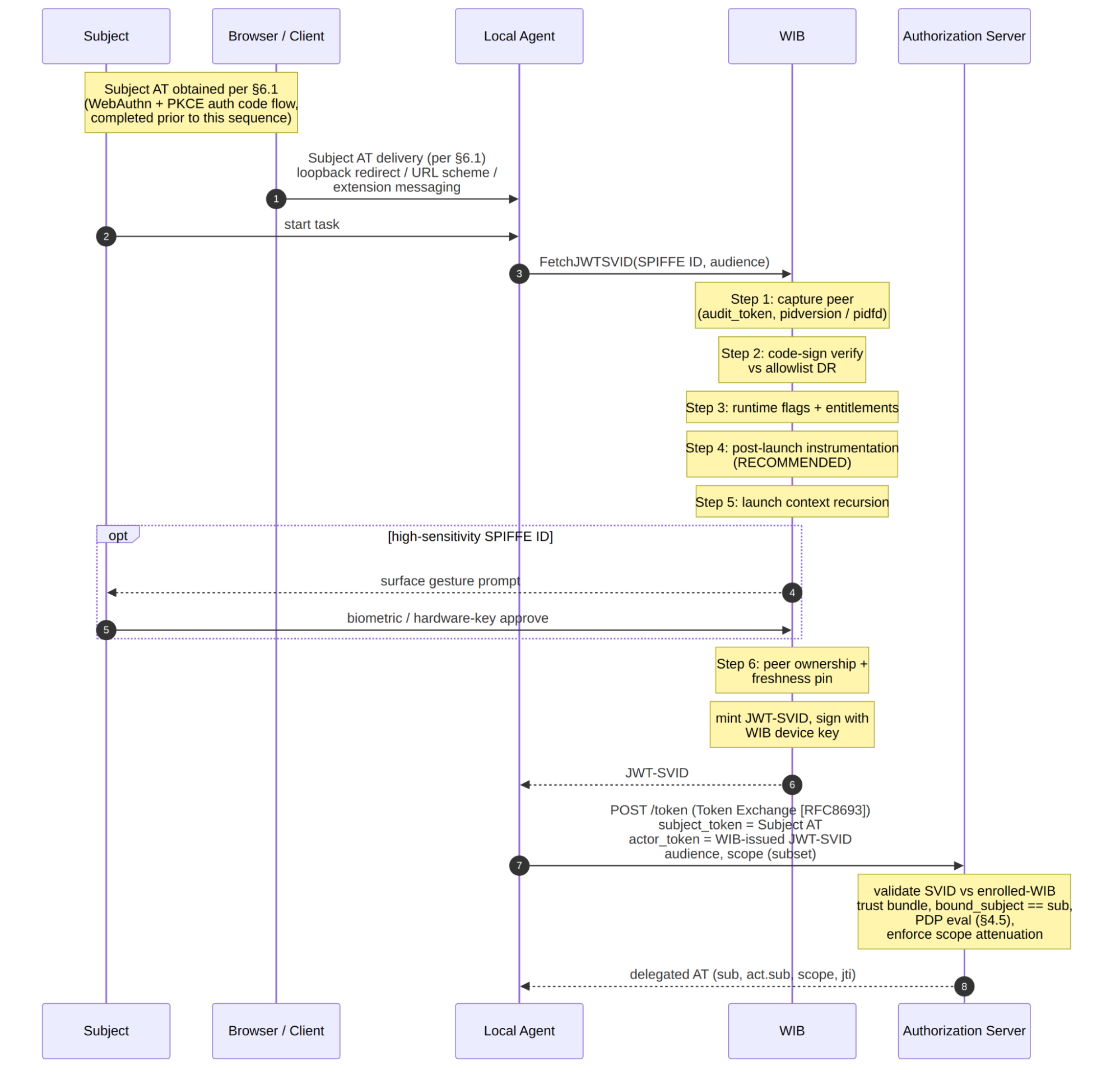
Sequence 5.1: WIB-mediated agent identity issuance plus Token Exchange. The six-step verification of [OS-Workload-Attestation] §4 (AIMS Attestation) precedes JWT-SVID minting (AIMS Credentials, AIMS Provisioning); the SVID is then presented as actor_token in the AS Token Exchange (AIMS Authentication, agent leg).¶
Section 5.3 realizes the AIMS Identifier function. The identifier scheme is SPIFFE [SPIFFE], chosen because it is URI-formatted, hierarchically structured, and already integrated with the WIMSE family of workload-identity specifications referenced throughout this document.¶
Each agent workload instance MUST be assigned a SPIFFE ID per [WIMSE-IDENTIFIER] and [SPIFFE]. The identifier takes URI form:¶
spiffe://<trust-domain>/agent/<vendor>/<agent-type>/<instance-id>¶
Example (native local process):¶
spiffe://acme.com/agent/example-vendor/example-agent/8f3a2b1c-9d4e-11ec-b909-0242ac120002¶
Example (browser-sandbox, origin-scoped):¶
spiffe://acme.com/agent/<vendor>/browser-ext/<origin-hash>/<session-id>¶
The <vendor> segment MUST identify the agent’s
publisher and is bound to the code-signing identity verified by the WIB
(Section 5.2.4). The <agent-type> segment identifies the product.
The <instance-id> MUST be a UUIDv4 generated fresh at agent
instantiation; it MUST NOT be reused across sessions.¶
For browser-sandbox agents, the trust domain MUST reflect the registered origin of the web application, preventing cross-origin impersonation.¶
The SPIFFE ID is the sub claim of the WIB-issued SVID
and is propagated as the act.sub claim in the delegated access token
issued by the AS at /token (Section 7.1).¶
Section 5.3.2 realizes the AIMS Credentials function
for the agent-identity leg of the trust chain. The credential format is
JWT-SVID per [WIMSE-CREDS]; the AS-issued delegated access token
(Section 7.1) and the TTS-issued Txn-Token (Section 7.3) are the further
AIMS credentials produced downstream of this one.¶
The SVID minted by the WIB is a JWT signed with the WIB’s enrolled device key. Example claim body:¶
{
"iss":
"wib://<vendor>/device/<device-uuid>",
"sub":
"spiffe://<trust-domain>/agent/<vendor>/<agent-type>/<instance-id>",
"aud": "https://as.acme.com",
"iat": 1745000000,
"exp": 1745000600,
"jti": "9f8e7d6c-...",
"bound_subject":
"user:7f3a2b1c@acme.com",
"attest_methods": ["macos_codesign", "secure_enclave_devid", "user_gesture"],
"binary_id": {
"publisher":
"<team-id-or-publisher>",
"product_id":
"<bundle-or-product-id>",
"cdhash": "sha256:..."
}
}
¶
Claim semantics:¶
iss: identifies the issuing WIB by the identifier registered at enrollment (Section 5.2.2).¶
sub: the agent’s SPIFFE ID per Section 5.3.1.¶
aud: the AS endpoint URL.¶
jti: a unique identifier for this SVID, used by the AS for replay detection over the SVID’s lifetime and as one of the audit correlation handles consumed by AIMS Monitoring (Section 8).¶
bound_subject: the OS-level
user identifier the agent is bound to. The AS MUST verify that
bound_subject matches the sub of the Subject’s federated access token
in the /token exchange.¶
attest_methods: an array enumerating the verification methods that succeeded for this SVID issuance. This is the wire-level reflection of the AIMS Attestation outcome per Section 5.2.4. The AS MAY apply graduated trust based on this array (e.g., requiring secure_enclave_devid for production-resource scopes, or rejecting SVIDs that contain only user_gesture for high-sensitivity audiences).¶
binary_id: structured representation of the verified binary identity. Used for audit logging (AIMS Monitoring, Section 8) and policy evaluation at the AS.¶
SVID lifetime MUST NOT exceed 10 minutes and MUST NOT exceed the lifetime of any access token derived from it. Short lifetime is not optional: it is the AIMS Credentials property that bounds the blast radius of credential theft to the residual TTL plus the time required for revocation propagation per Section 8.3.¶
Audit logs and revocation operations need to associate
an observed agent action with the specific delegation event that
authorized it. This document achieves correlation using only standard
JWT claims, specifically the access token’s jti and the Txn-Token’s txn,
rather than introducing a vendor-specific delegation identifier. The
pair (AT.jti, txn) uniquely identifies a single agent action within a
single delegated task across all PEPs that observe it.¶
The AS MUST set a fresh jti on every delegated access
token issued at /token (Section 7.1). The TTS MUST set a fresh txn on
every Txn-Token issued at /txn-token (Section 7.3) and MUST include the
originating AT’s jti as an additional correlation claim in the Txn-Token
(the Txn-Token specification calls out this propagation pattern in
[OAUTH-TXN-TOKENS] and [OAUTH-TXN-AGENTS]). PEPs that admit a
request MUST log both identifiers per Section 8.1.¶
Earlier drafts of this document defined a custom dlg_id claim to anchor delegations explicitly. That mechanism is deferred to separate work (Section 12) where it can be defined as a complete specification rather than a paragraph in a profile document. Until then, the standard jti / txn pairing is sufficient for the correlation needs of this profile.¶
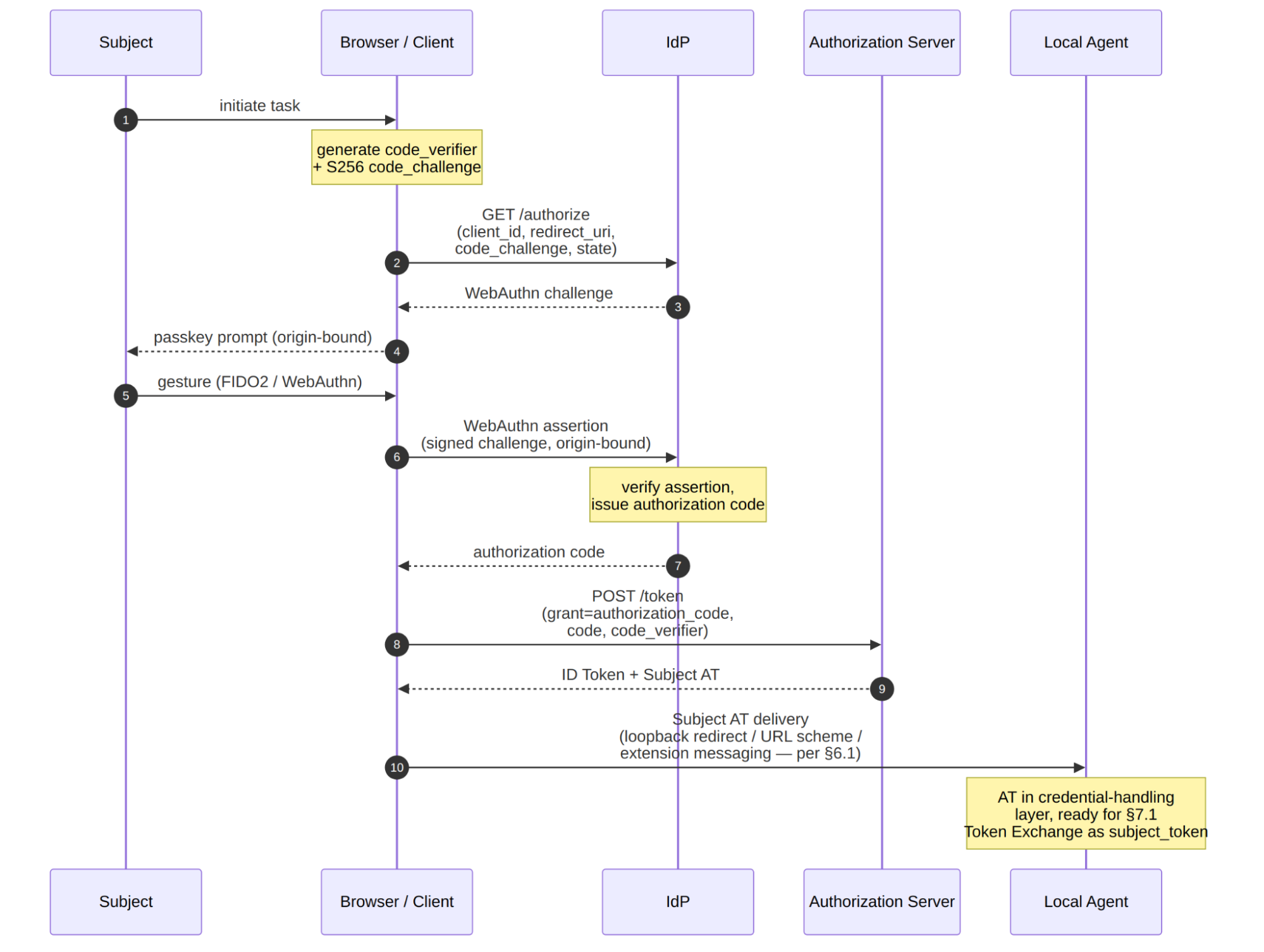
This section realizes the AIMS Authentication function. AIMS Authentication has two legs in the local-delegated profile: (a) the human Subject’s authentication to the IdP at delegation time (Section 6.1), and (b) the agent workload’s authentication to the AS at task time (Section 6.2). Both legs feed evidence into the downstream Authorization function (Section 7); neither alone is sufficient. The agent leg additionally consumes the AIMS Attestation output (Section 5.2.4) as the actor_token presented in Token Exchange.¶
The Subject MUST authenticate to the IdP using a phishing-resistant method prior to any delegation. Per [NIST-63-4] (finalized July 2025), the MINIMUM assurance level for delegating authority is AAL2. Synced passkeys satisfy AAL2; device-bound passkeys with hardware attestation satisfy AAL3.¶
The RECOMMENDED flow for local agent environments is:¶
Subject navigates to the agent’s authorization endpoint (or the agent triggers the OS browser to open the IdP authorization URL).¶
IdP presents a WebAuthn [WebAuthn-L3] challenge. The Subject authenticates using a device-bound passkey (TPM-backed on Windows / macOS via Windows Hello / Secure Enclave) or a FIDO2 hardware security key ([FIDO2-CTAP]).¶
WebAuthn assertion is verified by the IdP. On success, the IdP issues an authorization code.¶
The agent’s OAuth client (a public client, per [RFC6749] Section 2.1) exchanges the code for an ID token and access token, using PKCE [RFC7636] to prevent code interception.¶
The Subject AT obtained at the conclusion of the OAuth
Authorization Code flow is held by the OAuth client component that
completed the flow. For the agent to present this AT as subject_token
in the Token Exchange of §7.1, it MUST be delivered from the OAuth
client component to the agent’s credential-handling layer (§7.5.1) over
a channel that does not expose it to other same-user processes beyond
what the OS already permits, and that does not expose it to the LLM
context. The specific delivery mechanism depends on the agent’s
deployment shape: native CLI agents typically use a loopback redirect
URI [RFC8252], with the OAuth client’s redirect_uri pointing at a
localhost port the agent is bound to; native desktop agents typically
use a custom URL scheme or platform-specific deep-link mechanism;
browser-extension agents already operate in the same origin context as
the OAuth client and complete the flow without a cross-process handoff;
and IDE-integrated agents use the IDE’s secure-storage API or extension
messaging surface. In all cases, the AT is consumed once by the agent
(presented as subject_token to the AS at /token, after which the agent
holds only the delegated AT, not the Subject AT) and SHOULD be discarded
from the OAuth client component after handoff. The AT is short-lived per
the IdP’s policy; this specification does not constrain its lifetime,
only the delivery property.¶
PKCE is REQUIRED for all local agent OAuth flows per [OAUTH-v2.1] and [RFC9700] Section 2.1.1.¶
Sequence 6.1: Human authentication to IdP via FIDO2 + OAuth PKCE auth code flow. This realizes the human leg of AIMS Authentication. The Subject AT issued at the end of this flow becomes the subject_token for the agent Token Exchange in Section 7.1.¶
After the human Subject authenticates, the agent obtains its own short-lived credential through a Token Exchange [RFC8693], detailed in Section 7.1. This is the agent leg of AIMS Authentication.¶
The agent’s actor_token in this exchange is a JWT-SVID issued by the Workload Identity Broker (Section 5.2.3), not a self-asserted JWT; the AS validates the SVID’s signature against its enrolled-WIB trust bundle (Section 5.2.2) before processing the exchange. The SVID itself is the proof of agent identity. It was minted only after the WIB performed the six-step verification of [OS-Workload-Attestation] Section 4 against the connecting agent process and signed the result with the WIB’s device-bound key from the platform secure key store. From the AS’s perspective, accepting a WIB-issued SVID is equivalent to accepting an attestation that the WIB has verified the agent’s binary identity, runtime integrity, launch context, and ownership.¶
Token Exchange itself is a public-client OAuth flow per [RFC6749] Section 2.1 and uses the subject_token + actor_token grant of [RFC8693]. The agent does not hold a long-lived asymmetric key for client authentication and is not required to demonstrate proof-of-possession on the Token Exchange request itself; the actor_token (the WIB-issued SVID) carries the agent identity, and the SVID’s short lifetime, audience binding, bound_subject claim, and per-issuance attestation evidence collectively bound the trust placed in it.¶
Note on proof-of-possession on the issued AT.
The delegated access token issued at /token is a
bearer token in this revision. Per-call proof-of-possession is provided
by the Txn-Token (Section 7.3), which is short-lived (≤ 60 seconds),
carries an immutable identity and intent context, and is independently
issued by the TTS for each upstream invocation. Proof-of-possession on
the AT itself, by DPoP, mTLS, or another mechanism, is deferred to
separate work; see Section 12.¶
Agent credentials MUST be ephemeral. The following REQUIRED constraints apply, all of which derive from the AIMS Credentials property that an agent identity is bounded in time and scope to a single delegated task:¶
WIB-issued SVIDs MUST have a maximum lifetime of 10 minutes.¶
Agent delegated access tokens MUST have a maximum lifetime of 15 minutes.¶
Txn-Tokens (Section 7.3) MUST have a maximum lifetime
of 60 seconds per [OAUTH-TXN-TOKENS].¶
Refresh tokens MUST NOT be issued to local agent
clients for agent-scoped access tokens. If the access token expires
mid-task, the agent MUST request a fresh delegation through the WIB’s
Workload API (which will trigger fresh peer verification per
[OS-Workload-Attestation] §4) and a fresh /token exchange. The
absence of refresh tokens is itself an AIMS property: continuity of
authority across time is a Subject decision, not an agent
capability.¶
The agent process does not hold long-lived asymmetric key material in this profile. The WIB holds a device-bound key in the platform secure key store; the agent presents WIB-issued SVIDs (which the WIB has signed for it) and AS-issued bearer tokens, neither of which the agent itself signs.¶
This section realizes the AIMS Monitoring function.
AIMS Monitoring is the seventh and final function of the [NIST-AIMS] /
[AI-AUTH] model and the function that makes the other six accountable.
Without a per-action, correlatable, tamper-evident audit surface and a
real-time signal channel for policy events, the upstream Identifier,
Credentials, Attestation, Provisioning, Authentication, and
Authorization functions cannot be operated as a Zero Trust system: there
is no observation of whether they are doing what they are supposed to
do, and no mechanism to react when they are not. Earlier drafts of this
document folded monitoring concerns into other sections (a brief mention
in Section 5.4, the audit hint in Section 7.2, the revocation discussion
in Section 8.3); this revision consolidates them into a single
AIMS-aligned section. Correlation in this revision uses standard JWT
claims (the access token’s jti and the Txn-Token’s txn) rather than a
vendor-specific delegation identifier.¶
Every Policy Enforcement Point in the architecture (every Resource Server, the AS, and the TTS) MUST emit a structured audit record on every authorization-relevant event. The set of events is closed; conforming implementations MUST emit at minimum the following classes of record:¶
| Event class | Emitted by | Required correlation fields |
|---|---|---|
| Delegation issued | AS at /token | AT jti, sub, act.sub, scope, attest_methods, audience, exp |
| Delegation refused | AS at /token | sub, attempted act.sub, refusal reason class |
Txn-Token issued |
TTS at /txn-token
|
txn, at_jti, sub, act.sub, intent_hash, tool_call, resource |
Txn-Token refused |
TTS at /txn-token
|
at_jti (from presented AT), attempted action, refusal reason class |
| Resource access admitted | Resource Server PEP | txn, at_jti, sub, act.sub, resource, action |
| Resource access denied | Resource Server PEP | txn, at_jti, sub, act.sub, resource, action, deny reason class |
| WIB SVID issued | WIB | SVID jti, sub (SPIFFE), bound_subject, attest_methods, binary_id.cdhash, exp |
| WIB SVID refused | WIB | attempted sub, refusal reason class (per Appendix A.3 of [OS-Workload-Attestation]) |
| User-gesture surfaced | WIB | sub (SPIFFE), gesture mechanism, accepted / declined / unavailable |
| Token revoked | AS or upstream signal source | AT jti (or SVID jti for WIB-issued credentials), sub, act.sub, revocation reason class, propagation channel |
The refusal reason classes MUST be drawn from a closed namespace, identical at each emission site, so that operators querying audit data can compare across deployments. This document defines the closed namespaces in Appendix B (forthcoming in -01); until then, deployments MAY define their own provided the namespace is consistent within the deployment and version-stamped on every record.¶
Audit records MUST NOT include verification-step diagnostic detail beyond the closed-namespace reason class on emissions visible to the requesting peer. Detailed step-level failure information MAY be recorded in a separate, operator-only audit channel; this is the same separation defined in [OS-Workload-Attestation] Section 3.4 for WIB error responses, applied to the broader audit surface here.¶
The AIMS Monitoring function depends on being able to reconstruct, from audit records alone, the full identity chain of any observed action: which Subject, acting through which Agent, under which delegated access token, in which Transaction, against which Resource. The wire-level mechanism that makes this possible is the propagation of two standard JWT identifiers through every layer of the architecture:¶
at_jti: the access token’s
jti claim, set by the AS at /token (Section 7.1) and copied into the
Txn-Token by the TTS at /txn-token (Section 7.3) for cross-layer
correlation. The at_jti is the audit anchor for the per-task layer of
AIMS Authorization.¶
txn: the per-transaction
identifier minted at /txn-token (Section 7.3). The txn is the audit
anchor for the per-call layer.¶
The pair (at_jti, txn) uniquely identifies a single agent action within a single delegated task, across all PEPs that observe it. PEPs MUST log both. Audit-store schemas SHOULD index on at_jti to support the operational query “show me everything done under access token Y,” which is the canonical retrospective-investigation query for a delegated agent system. Both identifiers are standard JWT claims; no custom correlation field is required.¶
AIMS Monitoring is not only a backward-looking audit function; it is also the input channel for forward-looking policy reaction. When the Subject (or an automated risk system) determines that an active delegation has been compromised or should be terminated, the Monitoring surface is responsible for propagating that determination to every component that holds outstanding authority. Because this revision uses standard JWT claims rather than a custom delegation identifier, revocation is keyed on the access token’s jti (and, where the entire (Subject, agent) relationship is being revoked, on the standing delegation policy at the AS itself). The architecture has three time bands:¶
Immediate (AS, TTS). On a
revocation event for a given access token jti or a given (Subject,
agent) standing delegation, the AS MUST mark the affected token as
revoked in its token-introspection store, refuse all subsequent /token
Token Exchanges that would re-issue against the same standing
delegation policy until the policy is reauthorized, and refuse any
/introspect lookup that returns active for the revoked jti. The TTS
MUST refuse all subsequent /txn-token requests whose subject_token
has the revoked jti or has been issued against a revoked standing
delegation. Both responses MUST emit “refused” audit records per
Section 8.1.¶
Near-real-time (Resource Servers).
Resource Servers that have already accepted
access tokens or Txn-Tokens under the affected jti are not reachable
through the AS’s introspection store alone. The AS MUST emit a
Continuous Access Evaluation Profile [CAEP] event addressed to all
Resource Servers in the audience set of the revoked token, containing
the revoked at_jti and an event_type of “session_revoked.” Resource
Servers MUST consume CAEP events on a stream they configure with the
AS at relying-party registration time and MUST honor revocation events
within an implementation-defined latency budget. Deployments SHOULD
set the budget at single-digit seconds.¶
Eventual (token expiry).
Even without CAEP, the short-lifetime
properties of Sections 5.3.2, 6.3, and 7.3 bound the worst-case
exploitation window of a revoked-but-still-cached token: 10 minutes
for the SVID, 15 minutes for the delegated AT, 60 seconds for the
Txn-Token. CAEP narrows this to seconds; lifetime alone bounds it to
minutes. CAEP is RECOMMENDED rather than REQUIRED because not all
Resource Servers in the relevant ecosystem support CAEP receivers as
of the publication of this draft.¶
The user-gesture session model defined in
[OS-Workload-Attestation] Section 3.3 is invalidated by a defined set
of signals: explicit user dismissal, agent process termination, OS-level
user-absence (screen-lock, session-switch, idle timeout), CAEP receipt,
and elapse of the deployment-defined session ceiling. AIMS Monitoring is
the function that observes these signals and emits the corresponding
audit records (Section 8.1). On any session-invalidation signal, the WIB
MUST emit a “session_invalidated” record, the AS MUST refuse subsequent
/token requests whose actor_token references the invalidated session
until a fresh user gesture has been collected, and the TTS MUST refuse
subsequent /txn-token requests in the same manner.¶
Session invalidation is the local-trust-domain analog of CAEP: the same event surface, scoped to the local components, propagated through the local audit channel rather than over a network.¶
AIMS Monitoring serves two distinct audiences: operators (administrators of the deployment, who consume the audit channel) and Subjects (the human users whose delegations are being observed). Both audiences MUST be served, but the surfaces are distinct:¶
Operator surface. Structured audit records per Section 8.1, in a format suitable for ingestion by SIEM / log-aggregation systems. The operator surface is authoritative; audit records MUST NOT be elided or summarized in the operator channel.¶
Subject surface. A Subject-visible activity log accessible from the WIB UI (or an analogous credential-management product surface) that displays, in human-comprehensible form, the delegations the Subject has issued, the agents currently operating under them, and the resources those agents have accessed. The Subject surface MAY summarize and SHOULD redact internal correlation fields that are not meaningful to the Subject. The Subject surface MUST surface revocation as an explicit, gesture-confirmed action; revocation issued from this surface MUST propagate per Section 8.3.¶
The Subject surface is what makes AIMS Monitoring meaningful to the user whose authority is being delegated. A Monitoring function visible only to operators delegates the Subject’s oversight to the deployment; this profile requires that the Subject can directly observe and revoke their own delegations.¶
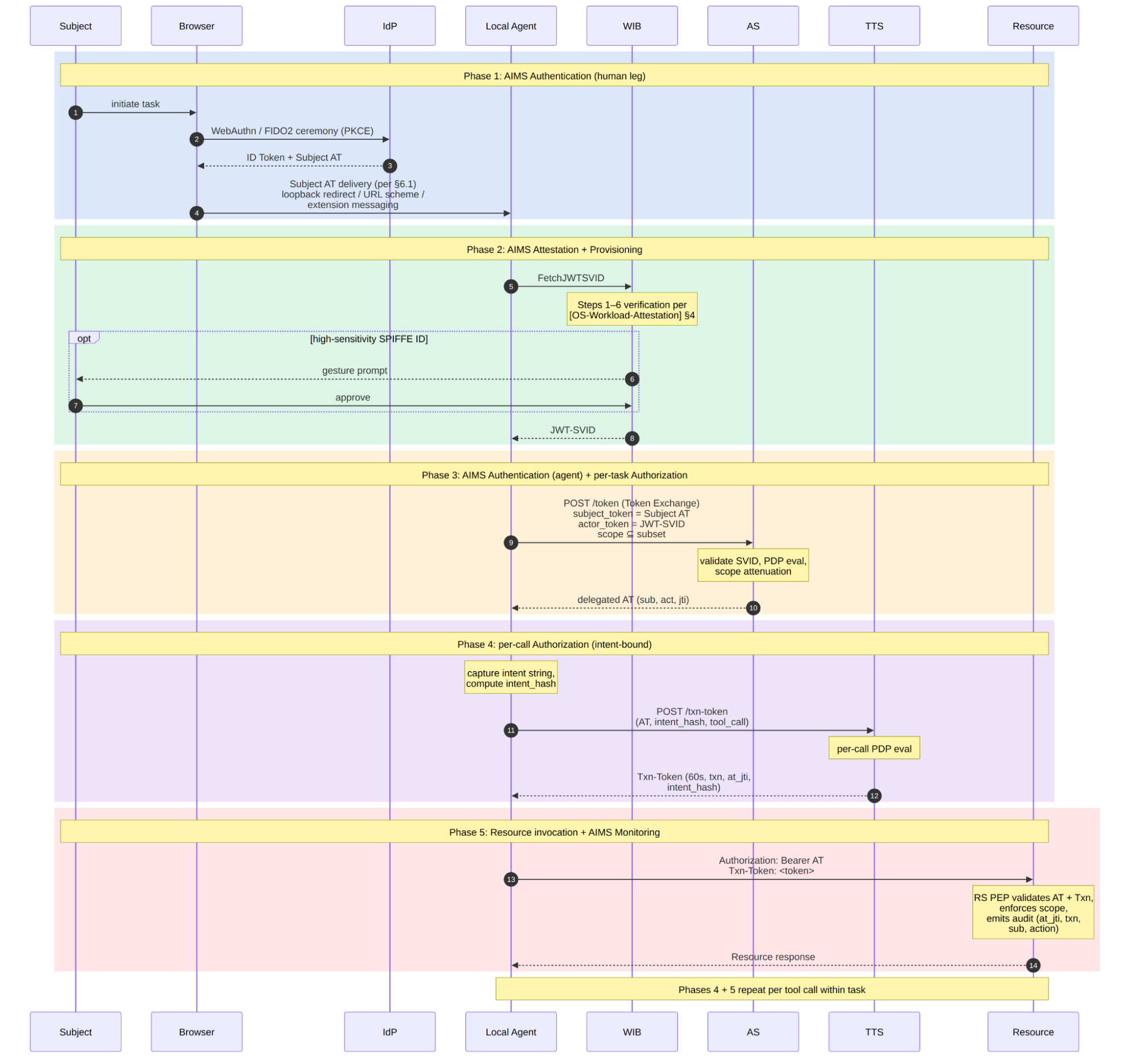
The following sequence covers the complete lifecycle of a single local delegated agent task, from human authentication through resource access, with each phase annotated to the AIMS function it realizes. The phase enumeration immediately below is the normative reference. Sequence 9.1, which appears after the phases, is the illustrative diagram. Where the prose and the diagram disagree (which they should not), the prose governs.¶
Phase 1: AIMS Authentication (human leg).¶
Subject authenticates to the IdP via WebAuthn / FIDO2 per Section 6.1. PKCE-protected OAuth Authorization Code flow yields a Subject access token bound to the Subject’s identity. The Subject AT is then delivered from the OAuth client component to the agent’s credential-handling layer per §6.1, ready for use as subject_token in Phase 3.¶
Phase 2: AIMS Attestation + AIMS Provisioning.¶
Local Agent connects to the WIB Workload API per [OS-Workload-Attestation] Section 3 and submits a FetchJWTSVID request naming the requested SPIFFE ID and audience. The WIB performs the six-step verification of [OS-Workload-Attestation] Section 4 against the connecting peer, surfaces a user gesture if the SPIFFE ID is high-sensitivity per Section 3.3 of the same document, and on success mints a JWT-SVID per Section 5.3.2 of this document.¶
Phase 3: AIMS Authentication (agent leg) + AIMS Authorization (per-task).¶
Local Agent presents the WIB-issued SVID as
actor_token to the AS’s /token endpoint, with the Subject’s access
token as subject_token and a requested scope. The AS validates the SVID
against its enrolled-WIB trust bundle, confirms bound_subject matches
the subject_token’s sub, applies graduated trust based on
attest_methods (Section 4.5 PDP evaluation), enforces scope
attenuation, and mints a delegated access token with sub, act.sub, and a
fresh jti per Section 7.1.¶
Phase 4: Intent capture + per-call AIMS Authorization.¶
Subject states the task as a natural-language string.
Local Agent computes intent_hash per Section 7.4 and POSTs the
delegated AT plus intent_hash to the TTS’s /txn-token endpoint. The TTS
validates the AT, runs PDP evaluation against runtime context (Section
4.5), and mints a Txn-Token per Section 7.3 carrying sub, actor.sub,
at_jti, intent_hash, and tool_call.¶
Phase 5: Tool execution + AIMS Monitoring.¶
Local Agent invokes the Resource Server with the
delegated AT in the Authorization header and the Txn-Token in the
Txn-Token header. The Resource Server PEP validates both artifacts,
enforces the requested action against the granted scope, and emits a
structured audit record per Section 8.1 carrying at_jti, txn, sub,
act.sub, resource, and action. The cycle of Phase 4 + Phase 5 repeats
for each tool call within the agent’s task; a fresh Txn-Token is minted
per call. Phase 5’s audit emissions are the input to the AIMS Monitoring
function for the entire task.¶
Sequence 9.1: Complete local delegated agent flow.
Phase 1: human authentication. Phase 2: WIB attestation and JWT-SVID
provisioning. Phase 3: per-task delegated AT issuance at the AS. Phase
4: per-call Txn-Token issuance with intent binding at the TTS. Phase 5:
resource invocation, scope enforcement, and audit emission. Phases 4 and
5 repeat for each tool call within the agent’s task; a fresh Txn-Token
is minted per call.¶
This section enumerates the security properties of the local delegated agent architecture and identifies specific gaps that are not fully addressed by currently available standards. Each gap is tagged for cross-reference. Gaps are organized by the AIMS function whose realization they affect, so an implementer or reviewer can scope their analysis to a specific function.¶
WebAuthn [WebAuthn-L3] with origin binding ensures that the human Subject’s credential cannot be replayed to a fraudulent IdP. The FIDO2 authenticator signs the challenge bound to the relying party’s registered origin; a phishing site at a different origin cannot obtain a valid assertion. This property holds for both native local agents (which open the OS browser for authentication) and browser-sandbox agents (where the WebAuthn ceremony is origin-bound to the application). This is the AIMS Authentication property that makes delegation trustworthy at the human leg.¶
The agent’s authentication to the AS does not rely on a long-lived agent-held key. Instead, agent identity is anchored in the WIB-issued JWT-SVID, which the AS validates against its enrolled-WIB trust bundle. The SVID itself is the proof of agent identity. It could only have been minted by a WIB that holds a key in its platform secure key store (Apple Secure Enclave, Windows TPM, or equivalent) AND only after the WIB performed the per-issuance peer verification of [OS-Workload-Attestation] Section 4. The security property substituted for client-held proof-of-possession is per-issuance binary attestation by the WIB, anchored in OS code-signing.¶
Prompt injection is a first-order threat for local delegated agents. An attacker who can influence the content returned by a tool call (e.g., a malicious SQL result payload, query response, or injected schema comment) may embed instructions that cause the LLM to take actions outside the user’s declared intent.¶
Current mitigations available in this architecture, organized by the AIMS function each leverages:¶
Intent Binding (AIMS Authorization, Section
7.4) ties the Txn-Token to a specific hash of
the user’s intent. Actions that meaningfully deviate from the intent
hash can be flagged by PDP policy.¶
Txn-Token scope binding (AIMS
Authorization): the tctx claim’s tool_call
field SHOULD enumerate authorized tool types. The PDP SHOULD refuse to
issue Txn-Tokens for tool calls not consistent with the declared
tool_call envelope.¶
Short Txn-Token lifetimes (AIMS
Credentials): a compromised Txn-Token has a
maximum 60-second exploitation window.¶
Human-in-the-loop re-authorization (AIMS Authentication): for high-sensitivity actions (e.g., write operations to production systems), the agent SHOULD surface a confirmation prompt requiring the Subject to actively approve, triggering a new WebAuthn ceremony.¶
Real-time CAEP signaling (AIMS Monitoring, Section 8.3): when prompt-injection-attributable behavior is detected by an upstream observer, CAEP propagates the revocation to all Resource Servers within the latency budget of Section 8.3.¶
Other processes running as the same OS user can read
the agent’s process memory, potentially extracting in-memory access
tokens or Txn-Tokens. This is a threat to the AIMS Credentials function
in the local trust domain. Mitigations:¶
Bound the exposure window via the short token lifetimes of Section 10.2.2 (15-minute AT, 60-second Txn-Token, 10-minute SVID).¶
Apply OS-level process isolation and ASLR; enforce code signing on the agent binary so the WIB’s peer verification (Section 5.2.4) refuses to issue SVIDs to tampered or replaced agent processes.¶
Minimize the lifetime of tokens in agent memory: the agent SHOULD discard tokens immediately after the request that uses them rather than caching them across the AT’s natural lifetime.¶
The WIB’s own device-bound key is protected by the platform secure key store (Apple Secure Enclave, Windows TPM, or equivalent) and is not loaded into application-accessible memory; see [OS-Workload-Attestation] for the WIB’s self-protection requirements.¶
Cross-origin information leakage:
Agent WIMSE IDs embedded in HTTP headers must
not be leaked to cross-origin iframes or third-party scripts.
REQUIREMENT: Authorization and Txn-Token headers MUST NOT be included
in cross-origin requests.¶
Service worker interception: A malicious service worker can intercept fetch requests and exfiltrate tokens. REQUIREMENT: The browser-sandbox agent MUST NOT operate in origins that permit untrusted service worker registration.¶
DOM-based prompt injection: Rendered web content (e.g., AI-summarized emails) can inject instructions into agent prompts if not sanitized. REQUIREMENT: All agent inputs derived from rendered DOM MUST be treated as untrusted and passed through a content sanitization layer before LLM context inclusion.¶
The following table summarizes the key differences between the local delegated architecture (this document) and the remote delegated architecture (doc 2 of 6). Both are AIMS reference architectures and use the same AIMS Authorization wire format (Token Exchange with act claim); they differ primarily in which mechanism realizes AIMS Attestation, where AIMS Credentials are stored, and the trust-boundary characteristics that shape the AIMS Monitoring function.¶
| AIMS function or property | Local Delegated | Remote Delegated |
|---|---|---|
| Execution environment | End-user device / browser | Cloud-managed container / VM |
| AIMS Attestation realization | OS code-signing via WIB ([OS-Workload-Attestation] §4); not hardware-rooted by default (Gap G-7) | Workload Identity Federation with cloud-platform identity issuer; SPIFFE / SPIRE + TEE available |
| Agent credential storage | WIB device key in OS secure key store / Secure Enclave / TPM; agent itself holds no long-lived key in this revision | HSM or cloud KMS; mTLS client cert per workload |
| AT proof-of-possession | None in this revision; per-call binding via Txn-Token
|
mTLS client certificate bound to AT (when [WIMSE-S2S] is used) |
| TTS location | Remote (cross-trust-domain) | Within remote trust domain |
| Human in loop | Present; FIDO2 consent feasible per task | Absent; delegation pre-authorized via ID-JAG |
Txn-Token issuance |
Cross-boundary (higher latency) | Same-domain (lower latency) |
| Prompt injection risk | Higher (local tool outputs) | Moderate (controlled tool outputs) |
| Refresh tokens | MUST NOT issue | SHOULD NOT; short-lived AT + rotation |
This revision is deliberately scoped to capabilities that exist in shipping or actively-drafted specifications today. The following items were considered during development and excluded; they are listed here so that an implementer or reviewer can locate work that has been deferred rather than abandoned, and so that the boundary between this reference architecture and the work that follows it is explicit.¶
Vendor-specific delegation identifier (dlg_id).
Earlier drafts of this document defined a
custom dlg_id JWT claim to anchor each delegation event distinctly
from the access token’s jti. Karl McGuinness’s review (see Acknowledgments)
observed that this is a custom mechanism deserving its own
specification rather than a paragraph in a profile document. This
revision uses the standard JWT jti and the Txn-Token’s txn for
correlation (Section 5.4 and Section 8.2). A future companion
specification may define richer delegation semantics and how to convey
them across token types; that work is not part of this
document.¶
Proof-of-possession on the delegated access token.
Earlier drafts bound the delegated AT to an
agent-held DPoP key per [RFC9449]. This revision does not, on the
principle that the architecture should be grounded only in
capabilities that exist in shipping specifications without requiring
the agent to manage long-lived asymmetric key material in the local
trust domain. The per-call binding properties that DPoP provided are
now provided by the Txn-Token layer (Section 7.3, Section 10.2.3).
Adding sender-constraining to the AT, via DPoP, mTLS, or another
mechanism, is appropriate future work for deployments that need to
defend against AT theft within the AT’s lifetime more aggressively
than CAEP-mediated revocation provides. Such an addition would be
additive to this profile and would not invalidate conformance.¶
Attenuating tokens for sub-agent delegation. Sub-agent flows (where one agent invokes another) are addressed in companion documents 3 through 6 of this series (the bounded and autonomous profiles). Recent IETF work on attenuating authorization tokens (draft-niyikiza-oauth-attenuating-agent-tokens-00) is relevant prior art and will be evaluated in those documents.¶
Capability-declaration system for intent binding.
Section 7.4’s intent_hash binds the Txn-Token
to a user-declared natural-language goal but does not mechanically
constrain agent tool calls (Gap G-3). A capability declaration system
in which the agent’s allowed tools are pre-enrolled and the Txn-Token
only authorizes specific declared capabilities would close that gap.
Such a system is not yet standardized; it is anticipated future work
in the [AI-AUTH] track.¶
Externalized PDP wire protocol. Section 4.5 specifies the PDP’s position and inputs but does not define a wire protocol for an externalized PDP. Deployments that externalize the PDP today use deployment-specific transports. A standardized PDP-consultation protocol is potential future work.¶
The authors thank the following individuals for review, feedback, and prior art that materially shaped this document:¶
Karl McGuinness for the architectural review that prompted the scope tightening reflected in this revision: specifically, the recommendation to separate the interoperable AIMS reference architecture from vendor-specific extensions, to ground the document in shipping or actively-drafted specifications, and to make the Policy Decision Point's role explicit (Section 4.5).¶
Nick Steele (OpenAI; co-author of [AI-AUTH]) for substantive discussion of the AIMS model and its application to local-execution agent profiles.¶
The authors of [AI-AUTH] / draft-klrc-aiagent-auth: Pieter Kasselman (Defakto Security), Jean-François Lombardo (AWS), Yaroslav Rosomakho (Zscaler), Brian Campbell (Ping Identity), and Nick Steele (OpenAI), whose elaboration of the AIMS conceptual model is the immediate parent of the function definitions used throughout this document. The mapping in Section 4.4 follows their seven-function decomposition; any errors of application are the responsibility of the authors of this document.¶
The authors of [NIST-AIMS] at the NIST National Cybersecurity Center of Excellence, whose concept paper introduced the AIMS framing that this document realizes for the local-delegated profile.¶
Acknowledgment does not imply endorsement; the named individuals reviewed material, contributed prior art, or co-authored upstream specifications that this document depends on. Responsibility for the contents of this document rests with the listed authors.¶
1Password Research & Development¶
https://1password.com/security¶
Document series: draft-1password-agent-identity-local-delegated-00, Part 1 of 6¶
Companion: draft-1password-os-level-workload-attestation-00 (AIMS Attestation + Provisioning realization)¶
Next document: draft-1password-agent-identity-remote-delegated-00 (AIMS reference architecture for the remote-delegated profile)¶